Is This Time Really Different?
From elections to recessions, why investors should tune out the noise and stay the course
As another presidential election rears its head, Americans are wrestling with questions beyond which candidate to choose. For investors, one major question is what the election will mean for the financial markets—and their own portfolios. They may worry whether the next administration will adopt policies that will help—or harm—the economy. And they may be concerned that political wheeling and dealing in Washington, D.C. will create new winners and losers in the stock market. With so much uncertainty in the air, many investors may be left wondering if they need to shift their portfolio strategy to successfully navigate the post-election environment.
It’s true that certain changes to the tax code or other policy decisions could have a financial impact on some investors. But the financial markets are influenced by a whole host of factors--not just who's controlling Congress or sitting in the White House. As most advisors would recommend only marginal portfolio changes, if any—and certainly not a complete portfolio overhaul.
“Investors systematically overestimate the degree to which the president can affect their portfolio, and underestimate the degree to which their personal behavior can affect their portfolio,” says Greg Ashcroft, an advisor with Baird Retirement Management. “If history is any guide, the person in the White House has very little bearing on what it is the market will or will not do.”
It’s not just elections that investors tend to put too much weight on. Other major events, whether expected or unexpected, can cause even the most seasoned investor to reconsider their portfolio strategy and make impulsive investment moves. But while it’s natural to feel anxiety about the unknown, there are considerable risks in letting today’s short-term worries drive long-term financial decisions. “History has proven that in times of uncertainty, it pays to stay the course,” Ashcroft says.
Contact the BRM Team
What history can tell us about uncertain times
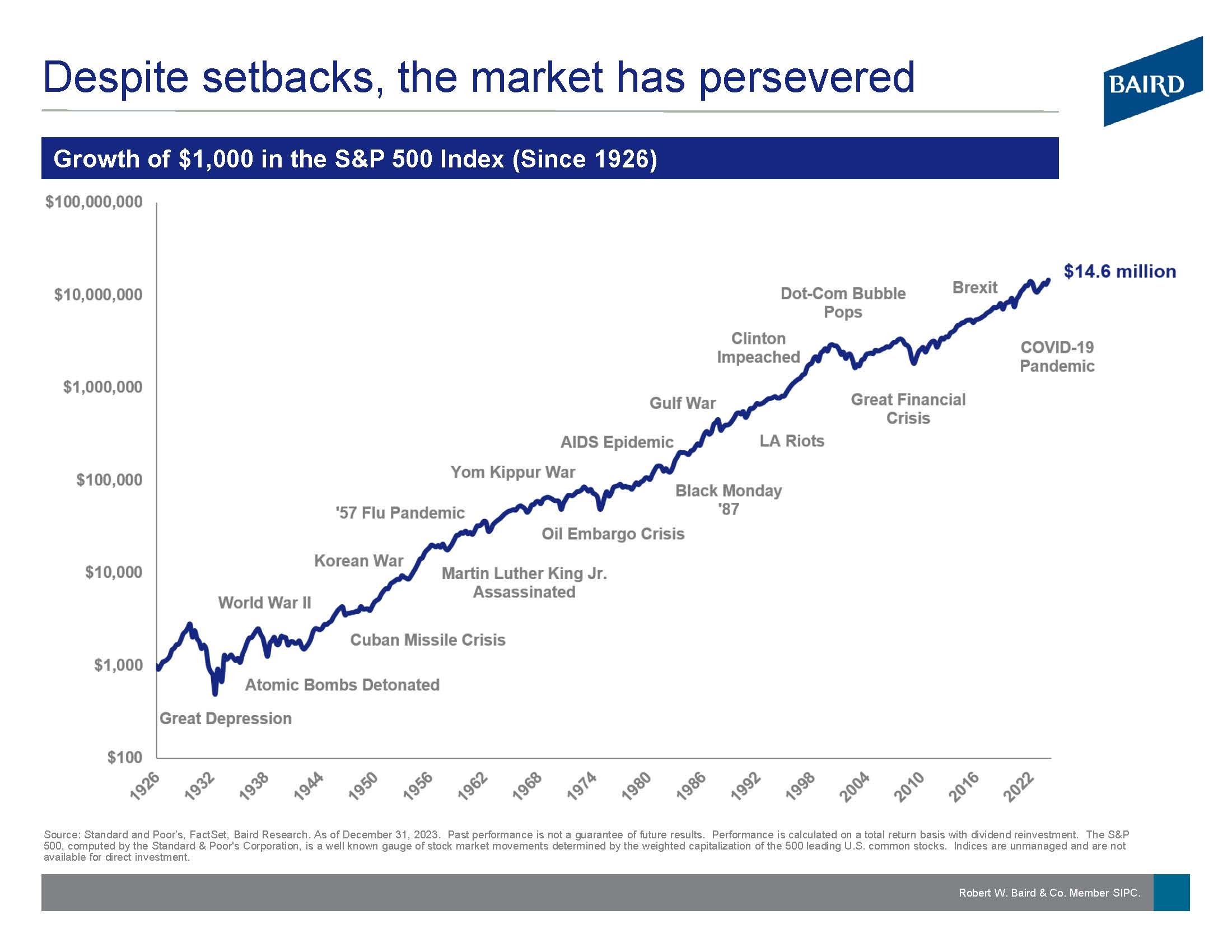
Investors have been through 25 elections over the past 100 years. During that time, they’ve weathered wars, political scandals and even a global pandemic. They’ve had a front-row seat to the births of new industries and watched as formerly great companies shrank into irrelevance. They survived the Great Depression and the Great Recession.
Some of these events precipitated difficult short-term losses for investors. Following the subprime mortgage crisis, from August 2008 to March 2009, the S&P 500 fell roughly 48%.1 While the Covid pandemic spread around the world in February and March of 2020, the S&P dropped about 34%.2
In both cases, many investors reacted by selling off holdings. But investors who stayed the course benefited from the market recoveries that followed. In the wake of the Great Recession, the recovery took a few years, with the S&P 500 reaching pre-recession highs in March 2013. After the pandemic dip of early 2020, that rebound came quickly: The S&P 500 was peaking again by August of the same year.
These recoveries are part of a much larger trend: Over long periods of time, the stock market has largely moved in one direction—up. In fact, from 1926 through 2023, the S&P 500 has delivered an average annualized return of roughly 10%.3 That means that if you invested $1,000 in the S&P 500 in 1926, you would have more than $14.5 million today.

That said, every year is different. In some years, stocks have soared to stratospheric heights and delivered huge returns to investors. Other years have been less kind to investors. For instance, the energy crisis in the early 1970s, the dotcom crash in 2000, and the Great Recession in 2008 and early 2009 sparked deep declines in the stock market. “It’s important to remember that any specific year will not necessarily be an average year,” says Moe Allain, a financial advisor with Baird Retirement Management.
But what the historical data unequivocally shows is that investors who have stuck it out through difficult years have been rewarded by recoveries and the long-term rise of the market. Given enough time, staying the course has paid off.
The temptation to take action
Historical evidence notwithstanding, it’s natural for humans to be fearful during times of uncertainty. Investors are no different. No one can predict the future, and it’s impossible to know how the stock market will react to a blip in the news cycle or a major global event. “We tend to focus on the things that lie dimly ahead rather than attending to the things that lie clearly at hand,” Ashcroft says.
It's also natural for investors to want to take action in the face of uncertainty, making decisions they believe will limit potential losses or otherwise protect their portfolio. When we’re not sure whether the next day will bring good news or bad news, we tend to do everything in our power to tip the scales in our favor.
Unfortunately, when it comes to investing, we’re not always the best judges of what will truly benefit us. Investors who make decisions in reaction to market trends or current events—whether it’s an economic slowdown, an emerging global conflict or a presidential election—often regret those choices. In 2023, the average equity fund investor enjoyed a return of nearly 21%. That lagged the performance of the S&P 500, which returned more than 26%. According to research firm DALBAR,4 one reason for this underperformance can be attributed to behavior: Investors tend to make the wrong decisions about when to buy, sell or switch into or out of their investments.4
In recent decades, the field of behavioral economics, which studies the motivations behind investor behavior, has helped explain why investors can make these self-sabotaging decisions. Behavioral economists have identified several biases that may lead investors to make bad decisions about their money.
Contact the BRM Team
Loss Aversion and Recency Bias
Understanding two common behavioral biases:
What’s behind the financial decisions we make? Often, these decisions are the product of behavioral biases shared by most people. Understanding these biases, however, can help investors more easily spot them and keep them from knocking their plans off track. Here are a two of the most common biases: Loss aversion is the tendency for the potential of a loss to feel more painful than the potential for a gain. For investors, loss aversion may lead them to adopt a more conversative approach than is appropriate. Recency bias is the tendency for investors to be strongly influenced by the latest news reports or market movements. However, making long-term financial decisions based on recent headlines can lead investors to chase hot stocks or sell in the wake of an unexpected market downturn.
One of the most common investor biases is loss aversion—the tendency of investors to fear losses more acutely than they anticipate the prospect of gains. As Ashcroft points out, loss aversion is a natural reaction. “If a client is upset by seeing losses in their portfolio, that’s the reaction I would hope they’d have,” he says. “If they weren’t upset, I would be concerned about whether or not they were really understanding what was in front of them.”
The problem arises when investors put too much weight on their fear of losses. It may lead investors to panic and sell when markets dip or adopt an overly conservative approach that limits the potential for losses—and the potential for growth.
Another common investor bias is recency bias. This is the tendency for recent events to have an outsized influence on investors, causing them to make ill-advised short-term changes to their long-term strategies. “Things that happened recently are going to be top of mind for basically anybody,” Ashcroft says. “It’s just how we work as human beings.”
The recency bias could manifest in the form of investors throwing all of their money on a few stocks that have outperformed over the past few months, for example. And it could be exacerbated by the herd mentality bias, the tendency for investors to follow the path of other investors, even if that path isn’t rational. If a group of stocks has been doing well lately, and a significant portion of investors overinvest in those stocks, the recency bias and the herd mentality bias could work together to drive investors to follow the money. Over the past couple of years, for example, investors have swarmed to the so-called “Magnificent Seven” tech stocks, which have been riding a hot streak. The problem is, today’s outperforming stocks can be tomorrow’s laggards. For investors that jumped in when prices were high, a reversal of fortune for a once high-flying stock can leave them in the lurch.
Investors aren’t wrong to have these sorts of biases. They’re a product of human evolution, hard-wired into our brains to protect us from real threats. If a tiger raided a village one night, there was a decent chance that it was still in the area and would be back the following night, and it made sense for villagers to be on guard. But the stock market isn’t a tiger, and short-term investing losses tend to transform into significant gains over time. “Our hardware is not well suited for the environment in which we find ourselves,” Ashcroft says.
The point, then, isn’t to get rid of our biases. It’s to become familiar with them and make peace with them. Gaining a better understanding of what drives our decision making can help investors rein in their impulses to take unwarranted action in times of uncertainty.
The virtue of staying the course
To stay on track toward your financial goals and avoid making hasty decisions, it helps to have a trusted partner who is focused on your best interests. “Financial advisors are there to prevent investors from falling into one of the many biases out there that can prevent them from making good decisions and not sticking with plans that are right for them,” Allain says.
Advisors can play a key role in helping investors map out a financial plan that is well suited to their unique situation and needs. At the center of that plan is an investment strategy that thoughtfully balances risk and return, helping an investor make progress toward their long-term goals without taking on more risk than necessary. These plans aren’t one-size-fits-all: Advisors tailor plans for individual clients, taking into account a range of factors that make up their unique financial picture, from their immediate financial priorities to the financial legacy they want to leave behind.
A well-constructed financial plan is designed to weather all kinds of market environments, from periods of sustained growth to times when the markets falter. That means a plan can keep investors on track during the moments when their resolve wavers. While it can be tempting to try to time the market, investors who stay the course through market dips and surges tend to generate much stronger returns than investors who buy and sell in response to short-term trends.
Investors who pull their money at the first sign of trouble may avoid short-term losses, but they may also miss out on attractive buying opportunities during market dips. What’s more, figuring out the best moment to get back in the market can be difficult, and sitting on the sidelines for too long may cause investors to miss out on gains. Consider that seven of the best 10 days of the S&P 500 from 2003 to 2022 took place during bear markets. Moreover, in 2020, the second-best day took place the day after the second-worst day. Investors who stuck to their plan were likely pleased when they saw that dramatic rebound.
For investors, reaching long-term financial goals takes discipline. It requires years of diligent saving and thoughtful decisions about how to spend. Extending this disciplined approach to managing their investment portfolio, with the help of a trusted financial advisor, can go a long way to helping investors reach their goals.
“Trying to time the market around volatility and uncertainty is almost never a very good long-term winning investment strategy,” Allain says. “Working with an advisor to construct a sound portfolio plan and sticking with it over the long haul almost always pays dividends.”
Sources:
1https://www.atlantafed.org/cenfis/publications/notesfromthevault/0909#:~:text=From%20its%20local%20peak%20of,(Bartram%20and%20Bodnar%202009).
2https://www.cnbc.com/2021/03/16/one-year-ago-stocks-dropped-12percent-in-a-single-day-what-investors-have-learned-since-then.html
3https://www.officialdata.org/us/stocks/s-p-500/1926?amount=1000&endYear=2023
4Data from DALBAR’s 2024 Quantitative Analysis of Investor Behavior report.
5https://www.visualcapitalist.com/chart-timing-the-market/